
On-site Planning

Installation & Commissioning

Automated & Energy Efficient
Client Name: C***L Citrus Cooperative
Country: Federative Republic of Brazil
Region: S?o Paulo State – The world-famous "Citrus Belt," Brazil's largest orange-producing region, accounting for over 75% of global orange juice exports
Core Products: Dried orange slices (for infusion), diced orange peel (bakery ingredient), orange powder (food additive), organic orange snacks
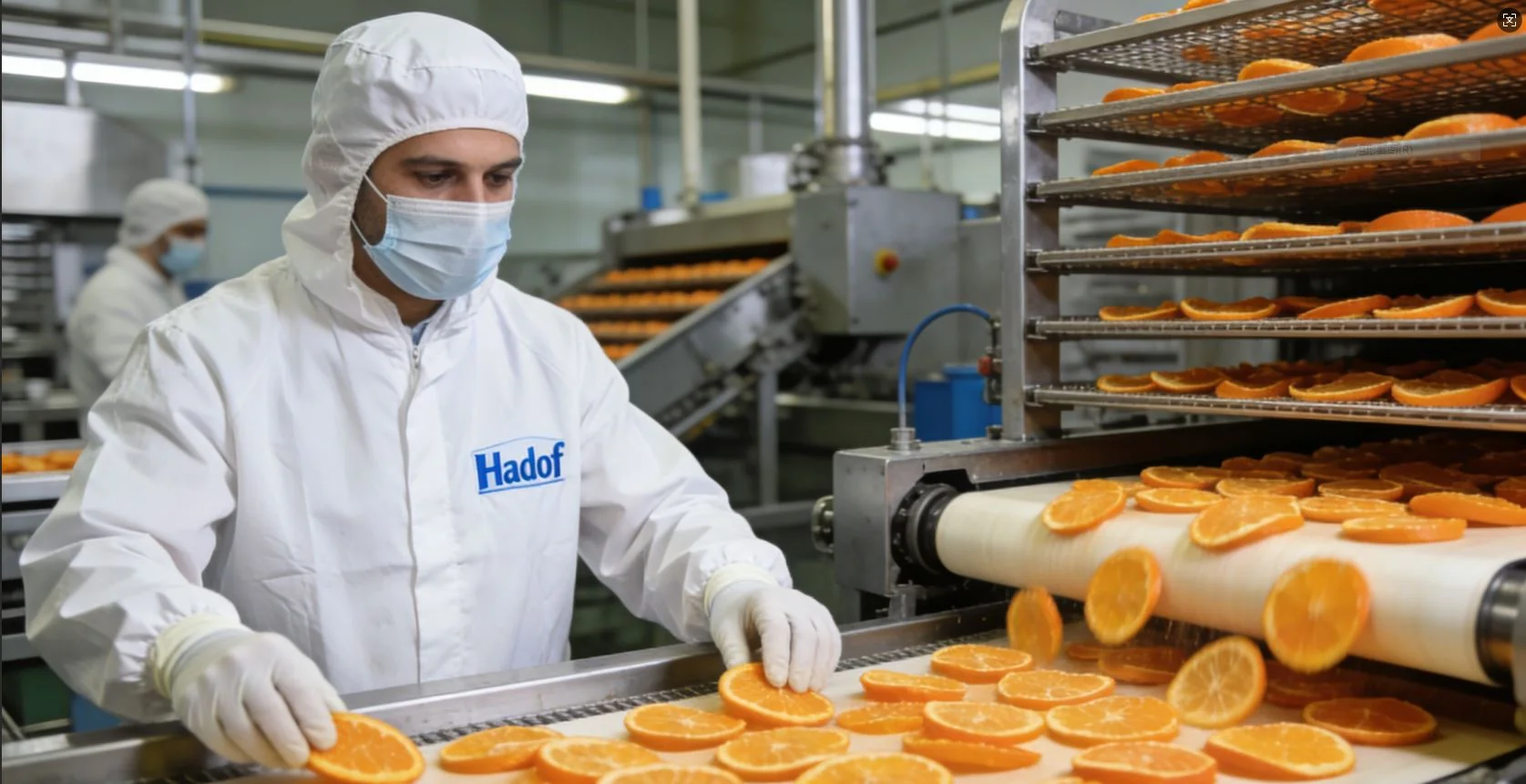
Equipment Configuration: Hadof customized multi-layer mesh belt hot air drying line (with integrated low-temperature vacuum drying and essential oil recovery modules)
Commissioning Date: Q2 2022
Brazil is the world's largest orange producer. The "Citrus Belt" in S?o Paulo state grows Pera and Hamlin oranges, supplying over 70% of global orange juice. C***L Cooperative, with over 50 years of citrus growing and processing history, represents over 500 member farms and produces over 500,000 tons of oranges annually. However, facing explosive global demand for natural health foods, the limitations of a single-processing model focused on juice became increasingly apparent.
Fresh Fruit Surplus & Grade B Predicament: About 70% of Brazil's oranges are juiced, but annually, fresh fruit with minor appearance flaws (skin blemishes, small size) cannot enter the fresh market or export channels and are juiced at very low prices (<0.2 BRL/kg), a huge waste.
Orange Peel Byproduct Waste: Juicing generates peel amounting to 40%-50% of fresh fruit weight, rich in pectin, essential oils, and flavonoids. Brazil produces millions of tons of peel waste annually, mostly used as feed or landfilled, wasting resources and creating environmental pressure.
Surge in Global Dried Orange Slice Market: Demand from Europe, North America, and Asia for dried orange slices and peel baking ingredients grows over 12% annually. Markets like Germany and France rely on imports, keeping prices high.
"Clean Label" Trend: markets demand additive-free, non-sulphured dried orange slices with natural aroma, which traditional hot air drying fails to deliver due to aroma loss and browning.
The client's needs were precise: fully retain natural orange aroma and vitamin C, achieve a natural orange-yellow color without sulphuring, and adapt to Brazil's variable grid stability and abundant biomass resources.
After comparing US and Spanish equipment, C***L Cooperative ultimately chose our company. Our advantage lay in developing a specialized aroma-protecting, color-preserving drying process for oranges, known for their rich essential oils, juicy flesh, and thick peel.
Solution: Three Custom Designs for Tropical Orange Characteristics
1. "Low-Temperature Vacuum + Essential Oil Recovery" Aroma-Lock System
Addressing the challenge of heat-volatile essential oils (mainly limonene) in orange peel, we used low-temperature vacuum drying combined with essential oil condensation recovery technology.
Low-Temperature Vacuum Locks Aroma: Under vacuum, the boiling point of water decreases, allowing drying at 45°C-55°C, far below traditional hot air drying (70°C-80°C). Orange peel essential oil retention exceeds 85%, aroma components like limonene are fully preserved, and vitamin C loss is under 12%.
Value-Added Oil Recovery: Small amounts of volatilized essential oils during drying are recovered via a condensation system and sold as natural orange essential oil raw material, yielding an additional 2-3 kg of oil per ton of fresh oranges, adding hundreds of BRL in revenue for the cooperative.
2. Flexible Process for Different Orange Parts
For Dried Orange Slices (core infusion product): Uniform 4-5mm slices undergo low-temperature vacuum drying for 10-12 hours. The final product is naturally orange-yellow with translucent edges, rehydrates quickly, and has an intense, lasting aroma. The non-sulphured process earns "Clean Label" certification.
For Diced Orange Peel (bakery ingredient): Peel is cut into 3-5mm dice and dried, retaining natural pectin and fiber for use in cakes, cookies, oatmeal, and jams. Product is orange-yellow with pure aroma.
For Orange Powder (food additive): Dried slices or peel are ground at low temperature into a uniform, fine powder for use in powdered drinks, seasonings, and baby food.
3. Dual Biomass & Solar Energy Drive
Brazil is a major producer of sugarcane and biomass energy. We designed a "Biomass Gasification + Solar Preheating" dual-energy system for the drying line, abundant local fuel sources like sugarcane bagasse, orange seeds, and peel waste.
Daytime: Solar preheating is prioritized, reducing energy consumption by 30%. Night/Cloudy: Switches to the biomass gasifier, fueled by the cooperative's own orange peel waste, making energy costs nearly zero.
Client Testimonial: "Golden Value" from Peel Waste to International Markets
After commissioning, C***L Cooperative's business expanded rapidly.
Capacity & Market Breakthrough
Throughput: Processes 30 tons of Grade B oranges daily, while also converting all peel waste from the juicing plant into high-value products. The selling season extends year-round.
High-End Market Access: The non-sulphured, additive-free low-temperature vacuum drying process helped secure EU Organic (ECOCERT) and US USDA Organic certifications. By 2025, dried orange slice exports to Germany, France, and the Netherlands grew 500%, with products entering mainstream supermarkets like REWE and Carrefour.
Significant Economic Benefits
Product Premium: Non-sulphured dried orange slices retail for �15-20/kg in Europe, 8-10 times the price of fresh fruit. Recovered orange essential oil sells for �40-60/kg, becoming a new profit center.
Return on Investment: Cooperative CEO Mr. Silva calculated: "We used to practically pay to dispose of Grade B fruit and peel waste. Now as dried slices and oil, they generate over 2,000 BRL per ton. With biomass energy costs near zero, we recouped the entire investment in under a year."
Environmental & Social Responsibility
Zero Waste Goal: Comprehensive orange utilization increased from 60% to over 98%. Peel waste is fully converted to high-value products, reducing organic waste landfill by about 15,000 tons annually.
Carbon Neutral Production: The biomass and solar systems cut the line's carbon emissions by 70%, earning Brazil's Ministry of Environment "Zero Carbon Factory" certification.
"We used to say that half of Brazil's oranges are juiced, and half are wasted. Hadof's drying line showed us that real technology unlocks the full value of every orange, letting the sunshine and aroma of S?o Paulo drift into teacups around the world with every dried slice."
—— C***L Citrus Cooperative, CEO Jo?o Silva