
Site Planning

Installation & Commissioning

Automatic & Eco-friendly
Client Name: W***G
Country: Canada
Region: Saskatchewan - the World's Bean Capital, core production area of Canadian peas, lentils and chickpeas, accounting for 30% of global bean trade volume
Core Products: Yellow Peas, Green Peas, Chickpeas, Red Lentils, Mung Beans, Black Beans, Kidney Beans, Lentils
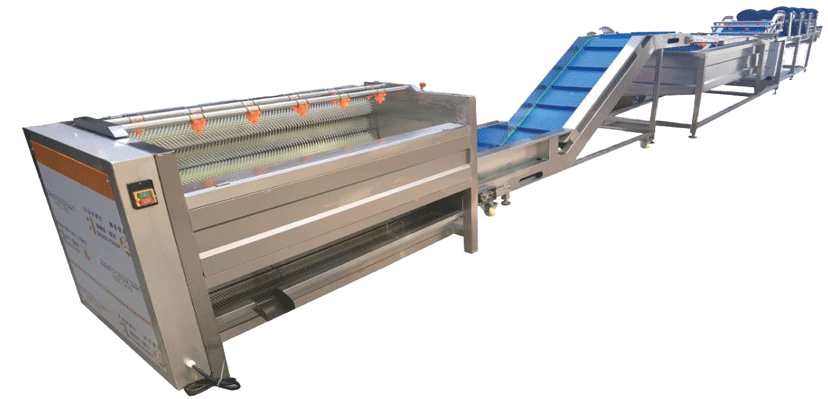
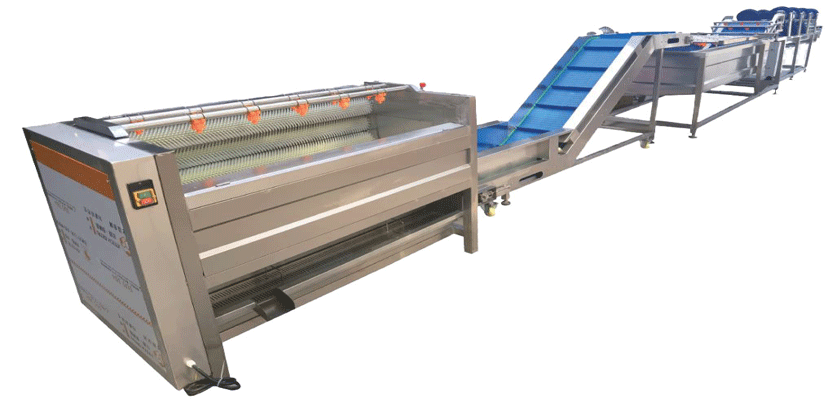
Equipment Configuration: Hadof customized gravity separation + ultrasonic cleaning + drum polishing combined bean washing line (compatible with stone removal, impurity removal and photoelectric color sorting system)
Commissioning Time: Q2 2024
Saskatchewan, Canada is known as the "World's Bean Capital". Peas and lentils produced here are exported to more than 100 countries around the world, especially South Asian markets such as India, Pakistan and Bangladesh. W***G is one of the largest bean exporters in the province, with an annual export volume of over 300,000 tons. However, as India and other countries impose stricter standards on impurity rates of imported beans, the traditional cleaning model is facing unprecedented challenges:
Difficult to Remove Similar-density Stones: Beans are often mixed with "similar-density stones" that have almost the same size and density as beans, which cannot be separated by traditional air separation. Indian customs have detected stones many times, facing the risk of goods return.
Dirt Hidden in Wrinkled Beans: Peas have natural wrinkles on the surface where soil and insect eggs hide, which cannot be cleaned by ordinary washing. Bangladeshi customers complained about "muddy taste in soup after cooking beans".
High Proportion of Damaged Beans: Traditional mechanical cleaning causes a 5% damage rate of beans. Damaged beans not only depreciate themselves, but also easily mildew and contaminate the whole container of goods.
Mildew Caused by Excessive Moisture: If the drying is not thorough after cleaning, beans are easy to mildew during 20-day sea transportation, resulting in a loss of over one million Canadian dollars for a batch of goods.
The customer's demands were clear: complete removal of similar-density stones, zero sediment in wrinkles, damage rate below 1%, and stable moisture below 14% after cleaning for long-distance sea transportation.
After comparing cleaning equipment from the United States and Australia, the customer finally chose our company. Our advantage lies in in-depth process adaptation for the characteristics of different beans, rather than general-purpose machines.
Solution: Five Customized Designs for Canadian Beans
1. Gravity Destoning + Air Suspension, 100% Similar-density Stone Removal Rate
Combining gravity destoner and air suspension technology, using the density difference between beans (1.3-1.4g/cm3) and stones (2.5-2.8g/cm3), similar-density stones are automatically separated to the waste area under the dual action of vibration and air flow. Tested by the Canadian Grain Commission, the similar-density stone removal rate is 100%, completely eliminating export risks.
2. Ultrasonic Cavitation + Flexible Brushing, Zero Residues in Wrinkles
Aiming at the problem of dirt hidden in pea wrinkles, a 40kHz ultrasonic field is added in the cleaning tank. The cavitation effect goes deep into the deepest part of wrinkles to shake out hidden sediment. Then gently brushed by flexible nylon rollers, the cleanliness inside wrinkles is 100% with zero damage to the bean surface. Indian importers randomly inspected 2000 peas without any sediment residue.
3. Vacuum Flotation + Vortex Separation, Removing All Insect Eggs and Bad Beans
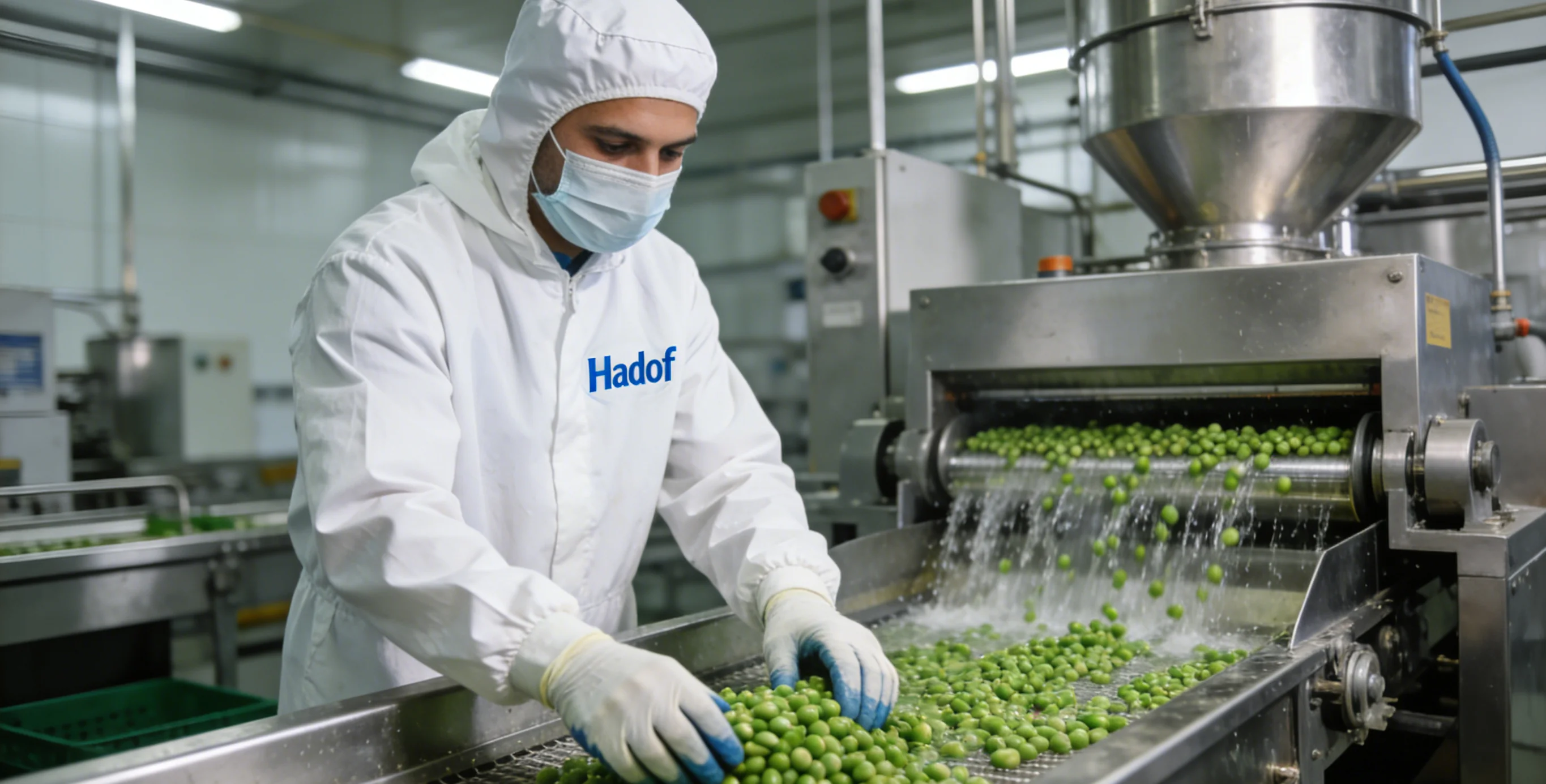
A vacuum flotation tank is integrated at the rear section of cleaning. Light impurities such as insect eggs and moldy beans float on the water surface and are automatically discharged by overflow; heavy stones sink to the bottom and are discharged regularly. Cooperated with a vortex separator, impurities in water are filtered instantly, and the recycling rate of cleaning water reaches 90%.
4. Drum Polishing + Photoelectric Color Sorting, Damage Rate < 0.8%
Adopting flexible drum polishing technology with food-grade polyurethane lining, beans roll and rub in the drum, improving surface smoothness by 50% while controlling the damage rate within 0.8%. Then processed by high-precision photoelectric color sorter, which removes discolored and moldy beans at a scanning speed of 2000 times per second, achieving 99.9% finished product purity.
5. Microwave + Hot Air Combined Drying, Accurate Moisture ±0.2%
A microwave pre-drying + hot air final drying system is integrated at the end of the cleaning line. Microwave penetrates inside the beans to quickly evaporate central moisture; hot air removes surface moisture. On-line monitored by near-infrared moisture meter, drying parameters are automatically adjusted, and finished product moisture is stable at 14%±0.2%, completely eliminating the risk of sea transportation mildew.
One year after commissioning, W***G has achieved a comprehensive upgrade.
Capacity and Market Breakthrough
Daily processing capacity: increased from 200 tons per day of manual line to 600 tons per day of continuous operation of automatic line, exceeding 800 tons per day in peak season, and on-time delivery rate rose from 75% to 99%.
Channel upgrading: Cleaned peas and lentils enter the supplier lists of top purchasers such as India's Adani Group and Thailand's CP Group with the label of "zero stones, zero sediment", priced 15% higher than ordinary products. In 2024, exports to India increased by 80%, and exports to Bangladesh doubled, regaining the top share in the South Asian market.
Remarkable Economic Benefits
Return on investment: The company's production director calculated: "We used to need 150 workers for sorting and cleaning, but now the whole line only needs 12 people. Labor costs are saved by more than 6 million Canadian dollars a year, and coupled with reduced losses, the equipment investment is recovered in less than 22 months."
Loss reduction: Damage rate reduced from 5% to 0.8%, saving more than 3 million Canadian dollars in annual losses; impurity-related return rate reduced from 10% to 0, avoiding losses of more than 8 million Canadian dollars.
Industry Benchmark
The production line has become the first bean washing line in Canada certified by India BIS standards, winning the "Agricultural Export Innovation Award" of Saskatchewan and driving the technological upgrading of the entire production area.
"Hadof's equipment has made our Canadian peas gain recognition in the Indian market. In the past, Indians said our beans had stones, but now they say these are the cleanest peas they have ever seen. This is the pride of Canadian agricultural products."
—— W***G, Chief Executive Officer